Sunday, 2 September 2018

51st King's Own Yorkshire Light Infantry


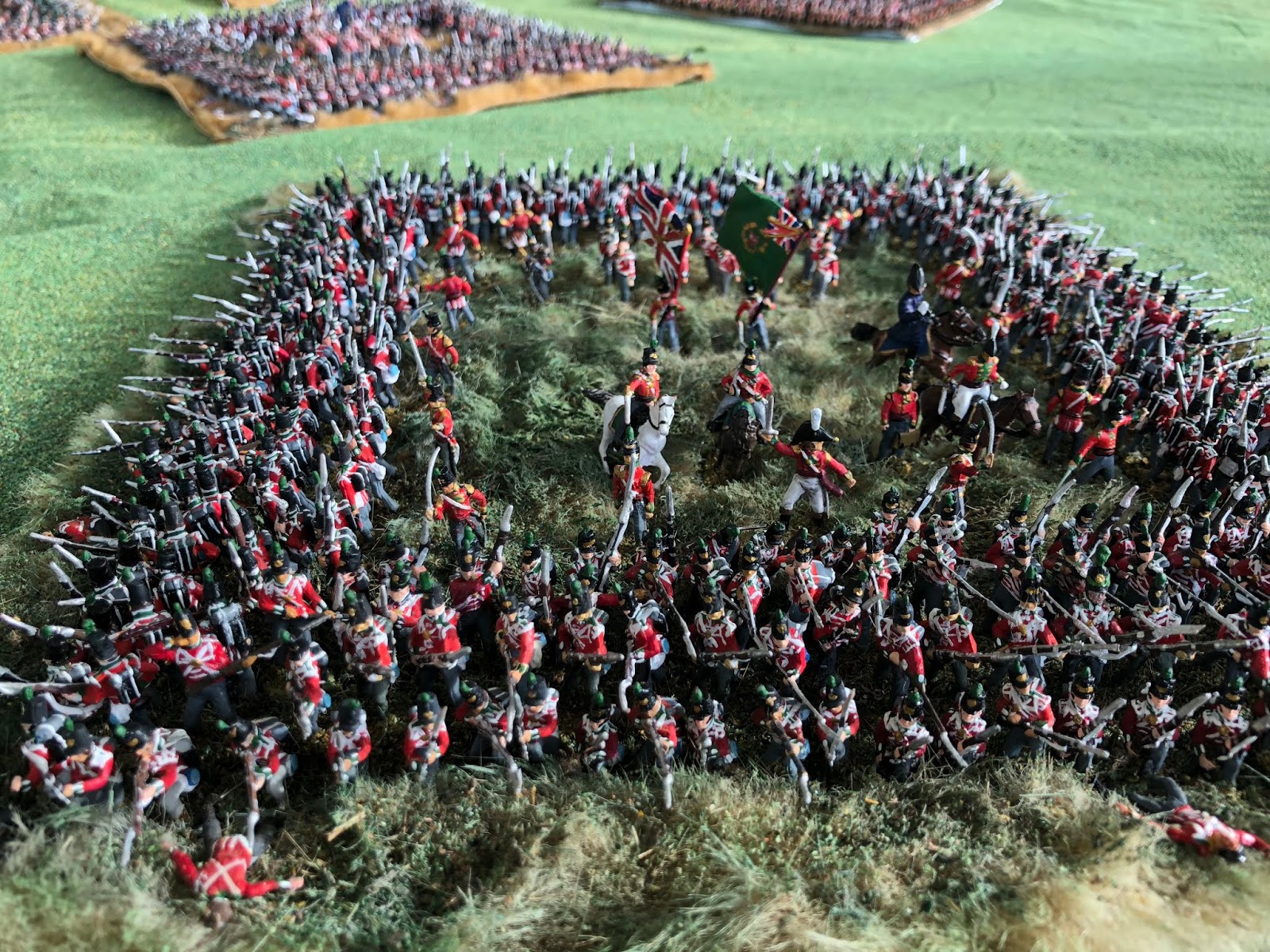
The 51st are shown here in square, which is how the bulk of the companies were formed at the peak of the French cavalry attacks, but my researches revealed a rather more classically Light Infantry role for the Regiment earlier in the battle.  While the overall role is easy to grasp there are aspects of the detail that are harder to follow, as this Regimental account shows:

"On the morning of the 18th June, the 51st was composed of two field officers, nine captains, 28 subalterns, six staff, thirty-nine sergeants, eighteen drummers and five hundred and twenty-one privates.  The battalion was part of Colonel Mitchell’s brigade being ordered to occupy a portion of the narrow road leading to the junction of the Hougoumont avenue with the Nivelles road towards Braine le Comte.


On the morning of the 18th, the brigade moved down to the right of the British position, and halted in columns of regiments about four hundred yards in rear of Hougoumont, awaiting in intense expectation the commencement of the action. The light company of the 23rd [Royal Welch Fusiliers] was then pushed forward to hold the avenue at its junction with the road. On its right was an abattis thrown across the great road, and close upon the right of this obstacle a company of the 51st was posted. Four more companies of the regiment, led by Captain Phelps, and the light company of the 14th were extended along the hollow way stretching across the ridge to the extreme left of the French position. It was their duty to engage the skirmishers covering the advance of Reille's corps and then inflict what loss they could upon the denser columns as they passed.

Siborne's map showing the 51st in square with skirmishers to the front


The remainder of the 51st stood initially in column of support and then in square, about 200 yards in rear of the hollow way. Owing to the undulating nature of the ground and the high standing corn, the skirmishers of the 51st, led by Captain Phelps, did not come in contact with the enemy's light troops covering the advance of their columns until within about forty paces; then opening fire and cheering loudly they pushed forward resolutely, causing the French to fall back, although supported by cavalry. [This would suggest that Reille's Corps advanced much further and in greater numbers around the North-West side of Hougoumont, it is hard to believe that is true so early in the battle].

Directly afterwards an order from Lord Hill caused them to retire upon the regiment where they remained the whole day close to Hougoumont, alternately advancing and retiring with the ebb and flow of the tide of battle.

During the heavy fighting between the British and French cavalry, who strove to penetrate the allied squares, a body of cuirassiers, having been intercepted in its direct line of retreat by a party of British Light Dragoons was induced to surrender; but taking advantage of the weakness of their escort, the cuirassiers suddenly broke away and galloped down the Nivelles road hoping to reach the French lines. They were fatally deceived. As they passed the high bank, covered with brushwood, on the right of the road where a detachment of the 51st was stationed in support of the light troops extended in front of the extreme right, they were fired upon, though but partially, in consequence of the close pursuit of the Light Dragoons.


The 51st take the surrender of Cuirassiers


This firing attracted the attention of Captain Ross of the 61st, who was stationed with his company more in advance, and close to the abattis thrown across the road, near the head of the Hougoumont avenue. Captain Ross, being thus prepared, also fired upon the cuirassiers, whereupon their commanding officer finding all further retreat cut off by the abattis, surrendered to Captain Ross, declaring he would not give himself up to the dragoons. Eighty of the cuirassiers and twelve of their horses were killed, and the remainder, about sixty, taken or dispersed.

In this position, which the regiment held until the close of the battle, it was several times furiously assailed by the French artillery as well as the cavalry. It also participated more or less in repelling the attacks on Hougoumont; but its severest struggle was, as we have already mentioned, with the skirmishers covering the advance of Reille's corps. Its total losses were eight rank and file killed: Capt. S. Beardsley, Lieutenant J. Flamank, Lieutenant 0. W. Tyndale, and twenty rank and file wounded. In the action with Reille's skirmishers. Captain Phelps's company of seventy men is said alone to have lost twelve men killed and wounded in about ten minutes.

In consequence of the victory. Colonel Mitchell and Lieutenant-Colonel Rice were appointed Companions of the Bath. The regiment bears the word " Waterloo " upon its colours. During the night succeeding the battle. Colonel Mitchell's brigade lay on their arms in the wood of Hougoumont, and early next morning commenced their march to Nivelles and its vicinity, where they remained for the night, as the troops had not been rationed for two days. At Nivelles Sir Charles Colville thanked the 4th Brigade for its distinguished bravery."


51st skirmishing

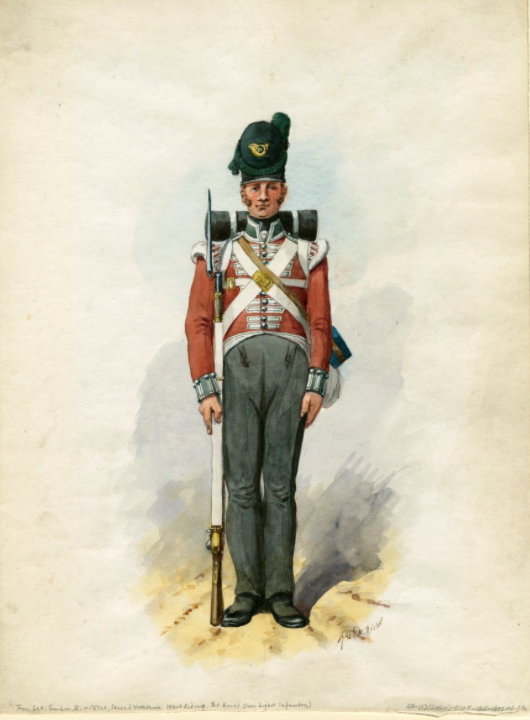
This picture shows a private of the 51st, but in a Belgic shako.  These replaced the old conical shakos after Waterloo, so this picture would not be right for 18 June 1815.


Turning now to my square, the figures are the usual mix of Hat, Emhar, Kennington, New Line, Hinton Hunt, Kriegspieler, with a great many conversions.


The Colour Party is Hinton Hunt

Emhar mounted officer with Mitchell the Brigade commander in the blue frock coat.


The officer is a Zvezda Russian artillery conversion


The whole square


A few pictures below of other squares, which are placed on some green scenery - clearly, in the final model they will be properly integrated with the landscape, following the crop scheme shown on the Siborne model.  The squares are also much closer together than in reality.


Monday, 25 June 2018

Hanoverian Battalions at Waterloo


I'm presently working on the 51st King's Own Yorkshire Light Infantry.  I've pretty much finished the figures, but research indicates that they acted as flank guard and were not in square - given their much more dispersed positions, it's going to take me a while to create a terrain section to reflect their role.

So in the meantime, I've done some research on the Hanoverians.  There is no subject more fiendishly complicated than that of the Hanoverian Field and Landwehr battalions at Waterloo. The battalions were in four brigades: those of Hugh Halkett, Kielmansegge, Vincke and Best.


Siborne's notes for his Waterloo Letters covers the subject in detail, but other sources contradict him to some extent. Colours of coats, leather equipment and headdress are subjects of controversy, all made harder by the fact that the Hanoverian Army was formed at short notice in 1813 and 1814, using surplus British stock and then morphed into new units with new equipment in 1815. Siborne describes the shakos as either:

'Portuguese', by which he meant Belgic, as follows:


or 'Tapered' (stovepipe), as worn prior to 1812 by British Line battalions and by Light Regiments until 1816:


Based on Siborne, the Hanoverians were dressed and organised as follows:

2nd Division, 3rd Brigade – Colonel Halkett.  North of Hougoumont
  • Osnabrück Landwehr Battalion. Red jackets with dark blue facings and grey pantaloons. All of the leather equipment was white. The battalion wore shakos of a tapered design, for which no foul weather covers existed. 
  • Quakenbrück Landwehr Battalion. Red jackets with dark blue facings and grey pantaloons. All of the leather equipment was black. The battalion wore shakos of a Portuguese design, which were normally supplied with the foul weather cover, worn as standard in all types of weather, to ensure that the headdress remained in good order. 
  • Salzgitter Landwehr Battalion. Red jackets with dark blue facings and grey pantaloons. All of the leather equipment was white. The battalion wore tapered shakos. 

  • Bremervörde Landwehr Battalion. Red jackets with dark blue facings and grey pantaloons. All of the leather equipment was white. The battalion wore tapered shakos. 

There is a note in Siborne's Waterloo Letters stating that the Hanoverian battalions of this brigade had British Trotter packs that were painted yellow. Could this have been true of all Hanoverian battalions?

3rd Division, 1st Brigade – Major-General Count von Kielmansegge - to the north-west of La Haye Sainte.
  • Lüneburg Light Infantry Battalion. Green jackets with black facings and green pantaloons. All of the leather equipment was black. The battalion wore shakos of a Portuguese design. Other sources suggest blue trousers, not green for this battalion, while others suggest that only the officers wore the blue trousers.


  • Kielmansegge's Feldjäger Corps. Green jackets with light gree facings and grey pantaloons. All of the leather equipment was black. The Jägers wore tapered shakos. 


The York and Grubenhagen battalions were in one double battalion square consisting of:
  • the Duke of York Light Infantry Battalion. Red jackets with dark blue facings and grey pantaloons. All of the leather equipment was white. The battalion wore shakos of a Portuguese design. This battalion was previously named the Benigsen Field Battalion and was originally equiped with British tropical issue shakos.  Siborne states that all shakos were black in 1815, but it would be interesting if some of this battalion had retained its white tropical headgear.


  • and the Grubenhagen Light Infantry Battalion: Red jackets with dark green facings and grey pantaloons. All of the leather equipment was black. The battalion wore tapered shakos. 
The Bremen and Verden battalions were in one double battalion square consisting of:

  • the Verden Light Infantry Battalion. Red jackets with light green facings and grey pantaloons. All of the leather equipment was white. The battalion wore shakos of a Portuguese design. There is one source that shows this battalion with a very strangely placed plume: 


Knotel shows the uniform more conventionally:


  • and the Bremen Light Infantry Battalion. Red jackets with black facings and dark blue pantaloons. All of the leather equipment was black. The battalion wore shakos of a Portuguese design. 

5th Division, 5th Brigade – Vincke.
  • Hameln Landwehr Battalion. Red jackets with dark blue facings and either grey or white pantaloons. All of the leather equipment was white. The battalion wore tapered shakos. 
  • Giffhorn Landwehr Battalion. Red jackets with dark blue facings and grey pantaloons. All of the leather equipment was white. The battalion wore tapered shakos. 

  • Hildesheim Landwehr Battalion. Red jackets with light yellow facings and grey pantaloons. All of the leather equipment was white. The battalion wore shakos of a Portuguese design. 
  • Peine Landwehr Battalion. Red jackets with light yellow facings and grey pantaloons. All of the leather equipment was white. The battalion wore shakos of a Portuguese design. 
4th Brigade – Colonel Best
  • Lüneburg Landwehr Battalion. Red jackets with dark blue facings and grey pantaloons. All of the leather equipment was white. The battalion wore tapered shakos. 
  • Osterode Landwehr Battalion. As above. 
  • Verden Landwehr Battalion. As above. 
  • Münden Landwehr Battalion. As above. 
Best and Vincke's brigades probably saw the least action of any formations at Waterloo, despite the intense fighting to their right in Picton's Division and to their left with the Nassauers around Papelotte.  For much of the day they stood in one giant square (really a rectangle) which must have been quite a sight.

Some sources disagree with Siborne:

  • The Grubenhagen Field Battalion is sometimes shown in dark green rifle uniform with black facings. 
  • The Osterode Landwehr - all other sources show with green facings. 
  • Kielmansegge's Field Jager corps is usually shown with a Prussian style Landwehr cap (dark green with a light green band). 


A common trait  is now to show all Hanoverian militia in red Prussian style Landwehr caps (see below).


While it makes sense for the Feldjagers to be so attired, I'm less sure of the others: it's a trend that seems to have caught on without much substance behind it. I'm sure some soldiers in these battalions might have been issued with this headdress, but in the beat-up exercises that preceded the campaign, some fairly exacting inspections by formation commanders would have disallowed such liberties.
  • Siborne doesn't distinguish between officers' and other ranks' headdress.  Other sources suggest Landwehr officers wore Belgic/Portuguese shakos, while their men wore tapered. 


  • Siborne shows Field Battalion Luneburg with Portuguese/Belgic shakos, but Richard Knotel states that they wore Rifles shakos:


Having tried to explain the uniform and equipment of the Hanoverians, it is also interesting to explore their competence.  There is a tendency to view the KGL as the elite German element of the Allied Army at Waterloo and to assume that their fellow Hanoverians were of lesser quality.  A very different and in my view compelling perspective is provided by the GOC of Halkett's Brigade, General Clinton.

Clinton was a veteran of the Peninsula and had exacting standards which he expected the troops under his command to meet during the preparatory training.  For someone who did not suffer fools gladly, Clinton became increasingly impressed by the Hanoverians in Halkett's Brigade.

"There is every disposition in the officers and men to discharge their duty as is apparent by the manner in which they do what they understand and know to be their duty viz, keeping in order all that is entrusted to their care.  In no regiment of the British is the ammunition in the order in which it is in these newly raised & militia battalions.  Their companies too are more complete, every man is distinctly and satisfactorily accounted for."