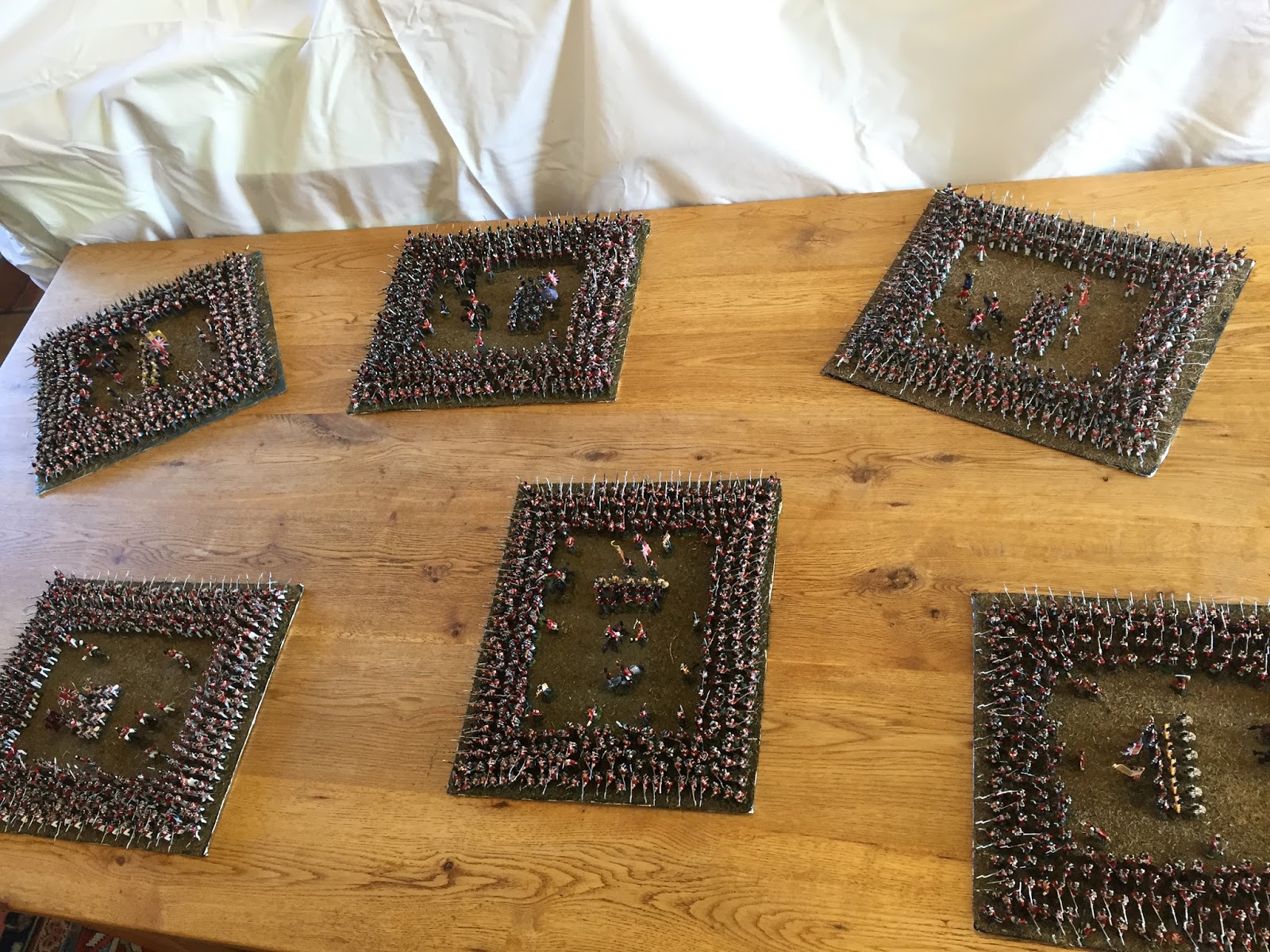
This blog is dedicated to recreating the Battle of Waterloo in 20mm figures. A simple enough proposition, one might think.
Most figures come sized at 15mm (often linked to 18mm) and 25mm (often linked to 28mm). Yes, there are plenty of outliers in smaller and some bigger scales, but these two are seen as the 'industry' standards.
Somehow, 20mm sits uncomfortably in the middle - a bit old fashioned, or a bit plastic (given the connection to 1/72). So why do I like 20mm?
To answer this, does anyone mind a bit of controversy?! To my taste, I find some metal 25/28mm figures too mannered, with over-sized hands, cartoonish faces and, frankly, some unsoldierly physiques. Even a cursory knowledge of the Napoleonic Wars indicates that a route march of twenty miles a day, coupled with the simplest of rations, did not give rise to either obesity or old age.
This slim look was exacerbated by the cut of many of their uniforms: tailoring in the early 19th Century was tight and anyone who has seen an authentic uniform from the period knows that they will often only fit a modern child mannequin.
Part of this problem is the same as the one that marks the difference between period re-enactors and real soldiers. The first are interested in uniforms, but have no real experience of soldiering. Compare and contrast the difference in these two photographs:


Spot the real soldier!
Vintage metal 20mm figures tend to avoid the lumpen characteristics of their 25mm counterparts. They are also more sparing in their representation of the human form, allowing the painter the chance to use his skill to insert missing detail. And plastic somehow lends itself as a material to more delicate representations.
I think there are some exceptional modern craftsmen working in metal in all scales, but on the whole, I find the 25/28mm figures less pleasing to the eye. It's a personal opinion, and I stand ready to be roundly criticised! Granted, all these arguments can be countered in one way or another: plastic figures can suffer from sculpting challenges and bending and there are plenty of metal manufacturers who avoid the grotesque.
There is also the simple question of cost: to recreate Waterloo entirely in metal figures would require a small fortune - the joy of plastic figures is that they provide mass at an affordable price, but can be supplemented by metal figures. There is also the fun of conversions - you can (and I do) convert metal figures, but plastic is a lot easier.
So I am a 20mm fan and the aim of this post is to explore how these different plastic and metal manufacturers can fit together. The question of scale has troubled model makers over the years, with some heated discussions about what defines the scale.
Despite the lack of agreement about what
constitutes 20mm, there is, paradoxically, quite widespread agreement about
which manufacturers fit the 20mm category.
That said, some collectors are very
specific about the range they will work in; because my diorama is set to be
quite large, this gives me more freedom to incorporate figures across the 20mm
spectrum.
So with all this in mind, this post shows
how I prefer to group my figures so that there aren’t too many glaring clashes
in scale.
I have divided them into the boxing weight
divisions:
Flyweight
Atlantic
Newline
Some Call To Arms
RSM
Battalionfeur
Newline
Some Call To Arms
RSM
Battalionfeur
Bantamweight
Airfix
Rose
Scruby
Esci
Franznap
Italieri 1st series
Revell
Waterloo 1815
Other Call To Arms
Rose
Scruby
Esci
Franznap
Italieri 1st series
Revell
Waterloo 1815
Other Call To Arms
Lightweight
Kennington
Hinton Hunt
Alberken
Imex
Hat
Hinton Hunt
Alberken
Imex
Hat
Welterweight
Zvezda
Kamar
Art Miniaturen
NapoleoN
Hagen
Falcata
Les Higgins
Kamar
Art Miniaturen
NapoleoN
Hagen
Falcata
Les Higgins
Middleweight
Italieri 2nd series
Strelets
Strelets
Heavyweight
Lamming
Minifigs S Range
In future posts I will try to explore some of the differences between each of these makes - each has its own character - some work well together, some don't.
Minifigs S Range
In future posts I will try to explore some of the differences between each of these makes - each has its own character - some work well together, some don't.